


The early years set the foundation for life long learning, health and well-being.
At Dianne's Home Daycare our goal is to provide a high quality, nurturing, and safe environment for the children entrusted in our care. We work along with the children's families to help the children develop physically, intellectually, socially, and emotionally. Our program supports the health and well-being of our daycare children. The individuality of each child is respected and encouraged. Our program reflects on the unique strengths, needs, and interests of current daycare children.
We welcome children between the ages of newborn and 6 years old, of any race, nationality and ethnic origin. We value diversity.
Our program In alignment with How does learning happen? (the Ministry of Education's framework), is based on the view, that all children are competent, capable, curious and rich in potential.
Our program is based on an informed understanding of what children are capable of learning and how they learn. Our program sets the foundation for literacy and numeracy. It's focus is on learning through active participation, exploration, experimentation, inquiry, and social interaction. The children explore play invitations and participate in creative and resourceful activities including: sensory bins, small world play, natural items and open ended play experiences.
We support, positive and responsive interactions among the children, parents and myself
-
We are available to assist parents /guardians, in-person, on facebook (messanger), by phone or e-mail, if there are any concerns or just to share photos, thoughts or ideas. (Please note: e-mails are not read daily).
-
We welcome parents/guardians to share news about their child and current life happenings.
-
We listen to each child and find out his/her interests, thoughts, and ideas.
-
We respect each child's differences and preferences.
We foster our Daycare children's exploration, play and inquiry
Our program builds on the current children’s expressed interests and ideas to offer learning environments, with invitations for children to participate, discover and engage in a meaningful way.
-
Comfortable spaces to share stories
-
Space and materials for building, problem solving and imagining
-
Space and materials that encourage creative expression and encourage children to share ideas
-
Space and materials for representing ideas with pictures and print
-
Outdoor active play and explorations
Open ended play invitations allow our daycare children to explore, be curious and engaged. This type of play promotes imagination and allows children to direct the play and their learning.
We enjoy watching our daycare children's ideas develop and evolve as they play. We listen to them verbalize their play invitations and encourage them to tell what they are doing or thinking.
Play is a means to learning that capitalizes on children's natural curiosity and exuberance.
Children make sense of the world through play. As children investigate and experiment through play they establish skills in problem-solving, social competence, self-regulation and communication. Imitating and exploring during the infant and toddler years evolves into "pretend" play. In pretend play, children use language and thinking skills. They learn to plan, negotiate, resolve conflicts, regulate emotions and behaviour, initiate friendships, and understand the perspectives of others.
Through these experiences, children build literacy, numeracy and scientific reasoning skills. Their natural curiosity inspires them to solve problems and overcome challenges.
Creative learning environments are offered in all play areas in my home to support children’s interests, responsive interactions and development.
We focus on teachable moments to expand children’s interests and knowledge. We learn along with the children. We follow the children’s lead and allow them to discover new things as they happen at their own pace. We involve children in the planning of activities which supports their sense of belonging. We discuss with parents/guardians their child’s experiences during the day.
The physical space in my daycare setting plays a significant role in learning and development. The environment welcomes children. Furniture, equipment, play materials, and supplies are organized to spark children's curiosity and enrich their explorations and interactions. The daycare environment reflects the unique needs of the children currently enrolled. Materials that reflect children's cultures (e.g. costumes, books, dolls, puppets, etc.) and provide an opportunity for learning daily routines (e.g. measuring cups, gardening tools, etc.) are provided.
Toy switches and centre changes happen frequently in order to keep children interested and to provide new experiences.
-
We recognize that responding to the unique abilities, needs and characteristics of each child, is important in supporting learning and development.
-
We engage with children as co-learners as they explore their environments.
-
We create meaningful programs, and guide interactions with children and their families.
-
We use a warm and positive approach to support children's developing ability to express emotions and consider other perspectives.
-
* It is important that all children feel they belong, have a sense of well-being, are engaged and participating, as well as expressing themselves. It is my goal that every child experience these four foundational conditions, each and every day.
We provide environments and experiences for children that allow for the exploration of their own ideas, investigation of their own inquiries, and the opportunity to interact with others through their play.
A well balanced program is offered which: includes quiet and active play; structured and unstructured play times; individual and group activities which are designed to promote gross and fine motor skills, language development and cognitive skills, and social and emotional development.
Our program is varied and flexible but also contains consistent routines to foster the children's sense of security.
We offer wide variety of interesting objects and open-ended materials (loose parts).
We have a wide variety of toys and activities available for children of different ages and abilities.
The physical spaces, materials, time, and experiences are organized in a way that supports the learning process.
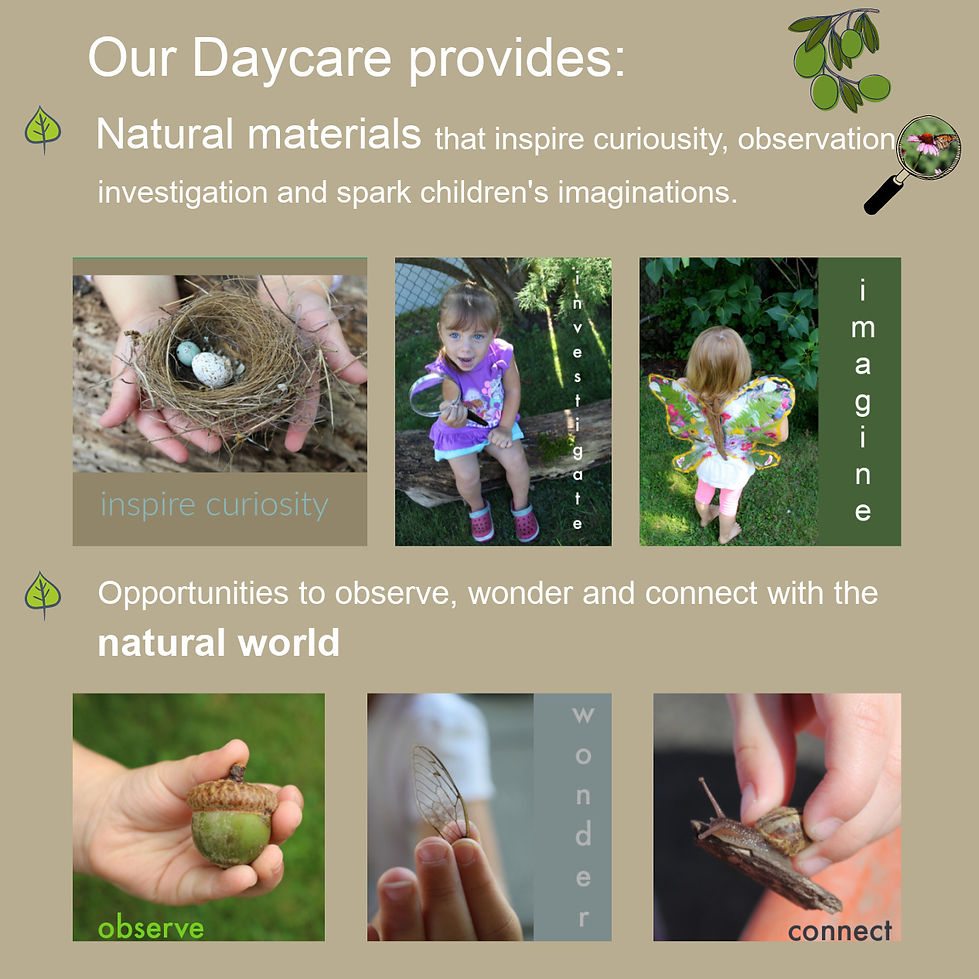
We utilize the environment as a third teacher. We offer a selection of activities for the children to participate in, where natural elements and nature are introduced into the play. We have several flower and food gardens, in which, the children are free to explore. The spaces provided for play are safe and engaging. Our children thrive in spaces that invite them to investigate, imagine, think, solve problems, and make meaningful experiences.
Rest and Quiet Time:
⦁ Our daycare children sleep/rest from 12:00 noon to 2:00p.m. daily. Arrangements and accommodations will be made for younger children which require two naps daily.
⦁ We have increased the space between each child's sleeping area to 2 meters. The
children are also placed head to toe or toe to toe as an extra safety precaution.
⦁ Each child has their own individual playpen/cot with their own bedding. Sleep areas and
bedding are not shared.
⦁ Quiet spaces are available for the children to participate in independent activities and for
rest times.
During the COVID-19 pandemic, we will:
⦁ Incorporate more individual activities that encourage space between children
⦁ Provide toys and equipment that can be cleaned and disinfected after each single use
⦁ Not use water tables/ pools
⦁ Remove toys that are mouthed by a child to be cleaned and disinfected before being
used again
⦁ During the COVID-19 pandemic, use of community playgrounds and social outings are
discontinued.
We foster the engagement of and ongoing communication with parents about the program and their children.
Early brain development is stimulated through experiences and interactions with responsive adults. A child's ability to regulate emotions, behaviour and attention increases over time, along with maturity, experiences and responsive relationships.
We make each child's experiences and interactions meaningful based on their unique abilities, interests, and life experiences.
Partnerships with families and communities help childhood settings best meet the needs of young children.
Family and community form the foundation for a child's early development. The needs of each child are considered in the context of their family composition, values, culture and language. This approach enriches relationships between early childhood settings, families and their community.
⦁ We maintain a positive welcoming climate where all family perspectives are encouraged,
valued and heard.
⦁ We value parents as partners and are always open to address issues and opportunities.
⦁ We arrange the environment so that the children are "at home", (e.g. display photos,
provide books and materials representing children's cultures and first language).
⦁ We initiate conversations with family members about their children's learning and
emerging skills in the program. We share information, photos and videos about
children's experiences and learning. (We do this through our facebook Daycare site).
⦁ We discuss with the parents/guardians how the child's play demonstrates learning and
development.
⦁ We support families with parenting challenges. We work through situations together.
⦁ We find ways for the children to make contributions to the community.
⦁ We respect all families. Respect for diversity, equality, and inclusion is vital
for optimal development and learning.
⦁ We recognize each child as a citizen with equal rights to live and learn.
⦁ We build programs based on the distinct early learning and child care needs of the
community.
⦁ We recognize and respect the unique qualities of each child and family, including
ancestry, culture, ethnicity, race, language, gender, family environment and
developmental abilities and needs.
⦁ We create strategies that value the culture and first language of all the children.
⦁ We establish program strategies to foster a learning environment in which every child
can participate.
⦁ We view the diversity of participants as an asset and plan the program to
reflect and celebrate these differences.
We value community partnerships with our Daycare to enhance the lives of children, families and staff.
The children made Christmas cards for all the residents at Northland Pointe for two years.
For our 25th Anniversary We painted 100 rocks with our Logo to be given out in the community.
We made bookmarks and magnets with our Logo and information to be given out in the community.
We provide links on our website to community resources and programs.
During COVID-19 we are not borrowing any books from our local library, but we are still using their online resources and courses.
We participate in continuous professional learning: We read, research and test out new ideas, crafts, activities, learning techniques and strategies on a daily basis. We also take online courses.
We observe and document the children's progress, goals and daily experiences.
Observation is a key responsibility of a daycare provider. The purposes are:
⦁ to gain insight into how children think, learn, and make sense of their world
⦁ to gather information to create programs that build on children's natural curiosity, ideas,
and abilities
Each child has an observation book to track their individual progress, record goals, and other pertinent information. This helps our providers to reflect on each child's unique development and to share the children's experiences with their families.
In Conclusion:
Our program provides a safe, engaging and fun learning environment, in a family setting, where children are actively involved in choices according to their interests and ideas.
We implement an age appropriate program that promotes each child's cognitive, language, physical, emotional and social development and well being.
Our daycare is an important support to families, healthy child development and school readiness.
Please Note:
This Program Statement is a work in progress. Visit often for the most up to date program information



In free play children learn to make their own decisions, solve their own problems, create and abide by rules, and get along with others.
Peter Gray